
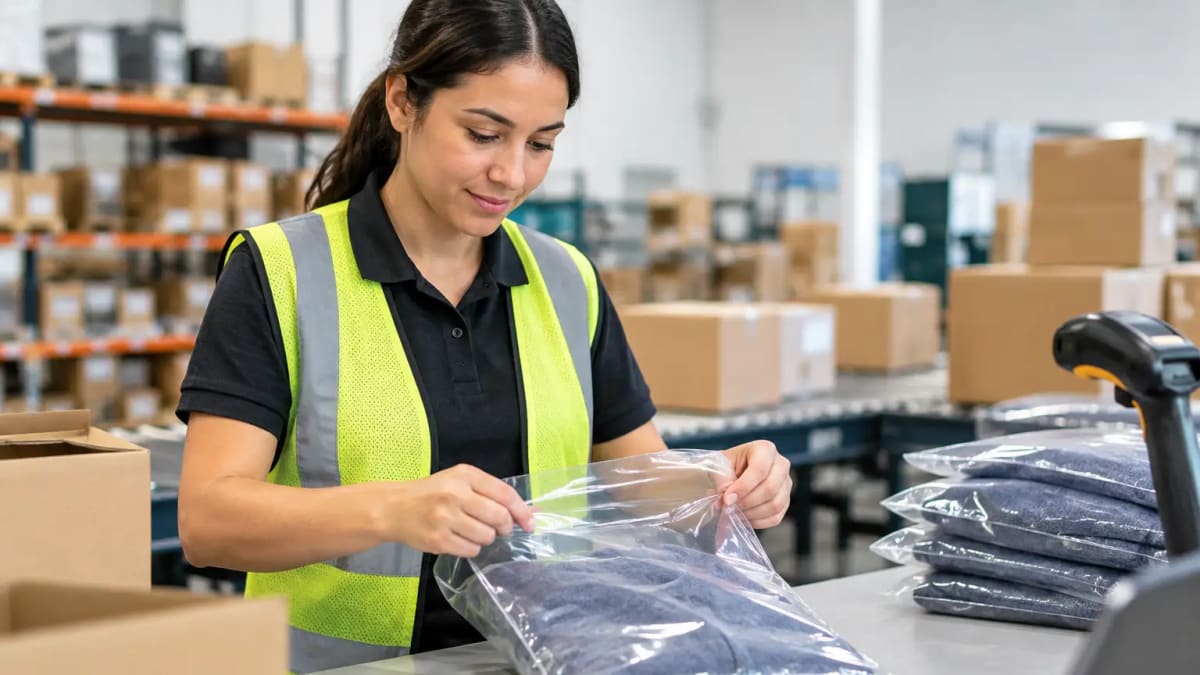
A product can arrive at an Amazon fulfilment centre on time and still be rejected before it reaches sellable inventory. A loose garment, an exposed barcode or a missing warning label can create delays, unplanned prep charges and disrupted stock availability. Poly bagging for Amazon is not simply a packing task. It is a controlled FBA prep process that protects the product, preserves scannability and helps your shipment meet Amazon’s current requirements.
For growing brands, the commercial impact is straightforward. Compliant prep reduces avoidable exceptions at inbound, protects customer-facing packaging and gives your team more confidence when sending larger replenishment volumes. The objective is not to use a poly bag for every unit. It is to apply the right protection, in the right format, with the right labels.
When poly bagging for Amazon is required
Poly bagging is commonly used where a product needs an additional protective layer before it enters the Amazon network. Clothing, textiles, soft accessories, loose items, products with easily marked retail packaging and multipacks are typical examples. It can also be required where the original packaging has an opening that could expose the item during handling.
The bag must protect the unit without creating a new problem. Amazon associates need to identify, scan and handle the product efficiently. If the bag covers the barcode, tears easily or leaves excess loose material, it may fail the purpose of the prep.
It depends on the product and the active Amazon preparation instructions assigned to your listing or shipment. Some retail-ready goods may not need bagging at all. Others may need a specific prep type, such as bubble wrapping, opaque packaging or secure bundling. Treat the shipment workflow in Seller Central as the final instruction, rather than relying solely on how a previous batch was prepared.
What an Amazon-ready poly bag should achieve
A well-prepared unit should arrive protected, sealed and ready to scan without the receiving team needing to open or rework it. In practical terms, the bag should be transparent, durable and fully closed. It must not have an open edge that allows the product to fall out or become exposed in transit.
The product barcode or FNSKU needs to be clearly visible and scannable through the bag where appropriate. If the retail barcode is not the barcode Amazon should scan, apply the FNSKU label to the outside of the bag in a flat, accessible position. Do not place it over a seam, fold or wrinkle. Labels applied around corners or across bag closures are more likely to lift or scan poorly.
Where a unit has multiple barcodes, avoid creating ambiguity. A scanner should identify one intended sellable unit, not several possible codes. This may mean covering an unwanted barcode or ensuring the FNSKU is the obvious scannable label. The correct approach depends on your Amazon barcode settings and the way the product has been registered.
For bags with an opening of five inches or more, a suffocation warning is generally required. The wording, type size and placement need to meet Amazon’s current policy. Do not assume a small sticker is sufficient because it was accepted previously. Requirements can change by marketplace, product category and bag size, so this should be checked as part of every approved prep specification.
A reliable poly bagging workflow
The best results come from treating poly bagging as one stage within a documented inbound process, not as a last-minute packing activity. Before a unit is bagged, the item should be counted, inspected and matched to the correct SKU. This prevents a packaging team from making a perfectly prepared error.
A practical workflow begins with product inspection. Check for damaged packaging, missing components, incorrect variants and old labels that could create scan conflicts. The team then selects a bag that fits the product closely enough to prevent movement, but does not compress or distort the retail packaging.
Once bagged, the unit is sealed and labelled. The FNSKU is verified against the product and placed consistently. A final scan confirms that the label resolves to the expected SKU. For products with preparation instructions, quality control should also confirm that warning labels, bundle labels and any additional handling labels are present.
The final stage is cartonisation. Prepared units need to be packed into outbound cartons with sensible weight distribution and sufficient protection for the journey to the fulfilment centre. Poly bagging protects individual units; it does not remove the need for strong outer cartons and accurate shipment information.
Quality checks that prevent costly exceptions
Quality control is where compliant prep becomes scalable. A small number of checks can prevent repeated inbound issues across hundreds or thousands of units:
- Confirm the SKU, product variant and FNSKU match before the bag is sealed.
- Check that the bag is fully closed, clear and free from tears, excess air or loose openings.
- Scan every barcode position used in the process to verify readability.
- Confirm warning labels, bundle labels and barcode coverage follow the approved specification.
Barcode-validated checks are particularly valuable for wholesale catalogues and private-label brands with similar-looking variants. A wrong size, colour or pack count can be expensive once the inventory is distributed through Amazon’s network.
Common mistakes with Amazon poly bagging
The most common issue is using a bag that is too large. Excess plastic catches during handling, makes labelling inconsistent and gives the unit a poor presentation. It can also make cartons less efficient, increasing storage and transport costs. Choosing a close-fitting bag is usually the better operational decision, provided it does not damage the item.
Another frequent problem is applying labels before understanding the barcode plan. Sellers may place an FNSKU over a scannable manufacturer barcode, then send the same product through another channel where the original barcode is needed. For multi-channel operations, stock should be planned deliberately. Amazon-dedicated inventory can be labelled differently from inventory intended for Shopify, TikTok Shop or wholesale distribution.
Overlooking bundle requirements is equally risky. If two or more items are sold as one unit, the bagging and labelling must make that clear. The components need to remain together throughout handling, and the completed set should carry the correct sellable-unit barcode. Sending loose components with individual barcodes exposed can result in incorrect receiving or customer fulfilment errors.
Finally, do not use poly bagging to hide a packaging problem. If the retail box is crushed, poorly sealed or missing mandatory information, putting it inside a bag does not make it suitable for FBA. The underlying product packaging still needs to be fit for storage, handling and customer delivery.
Choosing between in-house prep and a 3PL
Preparing small, predictable batches in-house can work when volumes are low and your team has time to follow a stable specification. The trade-off is that every product change, new listing or surge in demand creates extra operational pressure. Staff need space, materials, scanners, clear work instructions and a process for resolving exceptions.
Outsourcing Amazon FBA prep becomes more attractive when replenishment volumes increase, product ranges expand or stock arrives from multiple suppliers. A specialist 3PL can receive inventory, inspect it, apply FNSKU labels, complete poly bagging, build cartons and forward shipments to UK Amazon fulfilment centres under one controlled workflow.
The value is not just labour capacity. It is consistency. SOP-led preparation, barcode validation and documented quality checks reduce the risk that standards vary between shifts or busy periods. For brands importing stock or managing several sales channels, a UK fulfilment partner can also hold inventory and allocate it between FBA replenishment and direct-to-consumer orders as demand changes.
PickPackPro supports this type of workflow from its Milton Keynes operation, combining Amazon-focused preparation with wider e-commerce fulfilment. That approach gives sellers a practical route to keep stock moving without building a separate internal prep function.
Build poly bagging into your replenishment plan
Poly bagging should be specified before stock lands, not after cartons arrive at the warehouse. Create a product-level prep sheet covering bag size, barcode placement, warning labels, bundle requirements, carton quantities and any product-specific handling notes. Review it whenever Amazon instructions, packaging or suppliers change.
This preparation gives your warehouse team or fulfilment partner a clear standard to work from. More importantly, it makes replenishment predictable. When every unit is protected, labelled and verified consistently, you spend less time resolving inbound exceptions and more time keeping your best-selling products available for customers.

Comments
Share your thoughts. No account needed — once posted, comments cannot be edited.
Loading comments…