
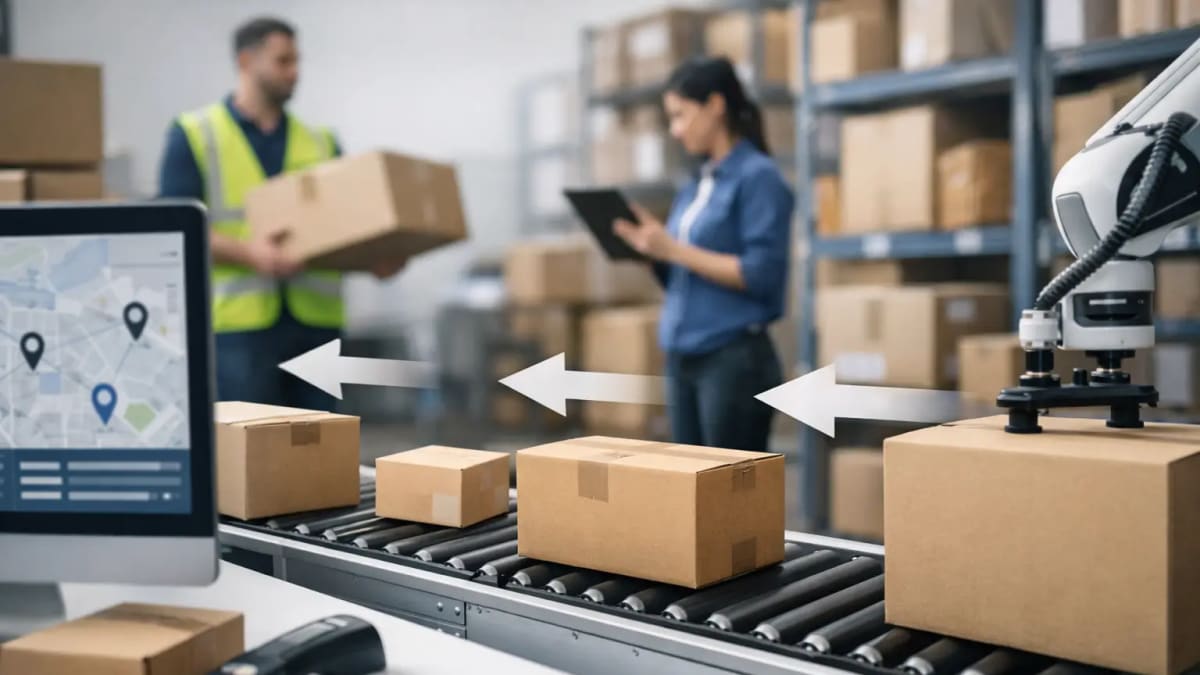
A fast-growing Shopify store can receive an order at 2:15 pm, while an Amazon customer places another at 2:17 pm and a TikTok Shop sale follows seconds later. Without clear order routing rules, those orders can compete for the same stock, be sent from the wrong location or miss a same-day dispatch cut-off. The result is not merely a warehouse inconvenience. It can mean higher carriage costs, cancelled orders, marketplace performance issues and disappointed customers.
For multi-channel sellers, routing is the decision-making layer between a sale being placed and a parcel leaving the warehouse. Done well, it directs every order to the right stock, workflow, carrier service and fulfilment location automatically. Done poorly, it creates manual exceptions that quickly consume the capacity your business needs to scale.
What are order routing rules?
Order routing rules are automated conditions that determine where and how an incoming order should be fulfilled. They sit within your order management or fulfilment system and use information such as sales channel, delivery postcode, stock availability, product type, order value, service level and cut-off time to select the most suitable fulfilment path.
A simple rule might send all Amazon Seller Fulfilled Prime orders to a specific operational queue with an approved courier service. A more advanced rule could prioritise stock held in Milton Keynes for mainland UK orders, while routing oversized products, temperature-sensitive items or products requiring specialist preparation to a separate workflow.
The aim is not to make routing complicated. It is to remove avoidable decisions from the dispatch floor. When the right logic is in place, warehouse teams receive clear instructions, stock is allocated with control and customers get the delivery experience they were promised.
Why routing matters when sales channels multiply
Self-fulfilment often works until order volume, SKU count or channel complexity increases. At that point, a team may be checking order notes manually, switching between marketplace dashboards and deciding which parcel service is cheapest or fastest. That approach is vulnerable to delay and human error, particularly during promotional peaks.
Routing rules create consistency across channels with different expectations. Amazon may require strict handling times, valid tracking and carrier performance. A Shopify customer may have selected next-day delivery. A wholesale order may need cartons labelled and booked onto a pallet service rather than dispatched as individual parcels. These orders should not enter one generic queue and rely on someone spotting the differences.
For sellers holding inventory across more than one site, routing also protects stock accuracy. The system can reserve stock from the preferred location before pick instructions are created. This reduces split shipments, prevents unnecessary internal transfers and helps avoid the costly problem of selling stock that is physically unavailable.
The routing decisions that deliver the greatest value
The most effective setup starts with commercial priorities, then translates them into operational rules. For most e-commerce brands, the first priority is service promise. If a customer has paid for next-day delivery, that order should take precedence over a standard-service order placed at the same time.
Stock availability is the next decision. Rules should allocate from the location that can fulfil the complete order where possible. Sending one order from two warehouses may be necessary when stock is fragmented, but it increases pick, pack and carriage costs. It also gives the customer two deliveries to track. A sensible system only splits orders when the customer promise or revenue opportunity justifies it.
Geography matters too. A UK mainland parcel may be best served from your central fulfilment site, whereas Highlands, islands, Northern Ireland and international destinations can need different carrier services, documentation or surcharge controls. Routing by destination helps protect both delivery performance and margin.
Product characteristics should also drive the workflow. For example, fragile products may need enhanced packing instructions; high-value items may require a tracked and signed service; lithium battery products may need carrier restrictions; and Amazon FBA stock may require FNSKU labelling, poly bagging or carton-level preparation before forwarding. The rule should identify the requirement before the order reaches the packing bench.
Finally, make channel-specific obligations explicit. Do not assume an Amazon order, a TikTok Shop order and a direct website order should be handled identically simply because they contain the same SKU. The routing logic must recognise the delivery method, labelling standard, packaging requirement and dispatch deadline attached to each channel.
Building order routing rules without creating exceptions
A routing framework needs to be detailed enough to control fulfilment, but simple enough for your team to maintain. Start by mapping the real journeys an order takes from checkout to carrier collection. Identify where manual decisions happen, why they happen and whether the decision can be made from reliable order data.
Set a clear hierarchy
Rules can conflict. An order might qualify for next-day delivery, contain an oversized item and be destined for a remote postcode. Decide which condition wins before automation is switched on. In most cases, customer service commitment and compliance requirements should outrank lowest-cost carrier selection.
A practical hierarchy usually begins with order holds and fraud checks, followed by channel service commitments, stock availability, product restrictions, destination requirements and cost optimisation. This prevents an apparently economical decision from sending an order through a route that cannot meet its promise.
Standardise product data first
Automation is only as reliable as the data it receives. Every SKU should have accurate weight, dimensions, barcode information, stock status and handling flags. If an item needs a particular carton, requires a serial-number scan or cannot travel through a certain carrier network, that information must be stored consistently.
This is especially relevant for Amazon-focused operations. A missing FNSKU, an incorrect label position or an unrecorded prep requirement can stop a shipment from being accepted. Product-level rules turn those requirements into repeatable warehouse instructions rather than last-minute checks.
Use cut-offs as operational controls
Same-day dispatch is not achieved by promising it in a checkout banner. It depends on a realistic handover cut-off, pick capacity, carrier collection times and the time needed for quality checks. Your rules should recognise when an order is received and assign the correct dispatch date automatically.
There is a trade-off here. Extending the same-day cut-off can increase conversion and customer satisfaction, but only if warehouse capacity and carrier collection windows support it. A rule that promises more than the operation can reliably deliver will create performance risk rather than competitive advantage.
Where a 3PL strengthens routing performance
A specialist 3PL can apply routing rules across the full fulfilment workflow rather than treating them as a storefront setting. That includes inbound stock control, barcode validation, picking, packaging selection, carrier allocation, tracking confirmation and returns processing.
At PickPackPro, this approach is supported by integrations across marketplaces and courier systems, allowing channel data to flow into structured warehouse processes. Orders can be prioritised against agreed service levels, while scanning and SOP-led checks provide a control point before dispatch. For a brand selling through Amazon, Shopify and TikTok Shop at once, that visibility is often more valuable than simply having another storage location.
The right partner should also support exceptions without making them routine. Some orders genuinely need human review: a damaged stock alert, an address query, a customer-requested upgrade or a stock discrepancy. The objective is to isolate these cases quickly, not let them block every other order in the queue.
Common routing mistakes to avoid
The first mistake is building rules around the cheapest carrier rate alone. The lowest label cost may become expensive if it produces failed deliveries, weak tracking or late marketplace scans. Cost should be assessed alongside delivery success, claim rates and customer contact volume.
The second is routing based on stock figures that are not updated in real time. If inventory synchronisation lags behind sales activity, automation can confidently allocate unavailable stock. Regular stock reconciliation and barcode-led receiving are essential foundations.
Another common issue is creating too many rules too soon. A complex rule set with overlapping conditions is difficult to test and harder to troubleshoot during peak trading. Begin with the decisions that have the biggest effect on service, compliance and margin, then add refinement once the core routes are proven.
It is also worth reviewing rules after carrier changes, new product launches, marketplace policy updates and seasonal peaks. Routing logic is operational infrastructure, not a one-off project. What worked at 50 orders per day may not be suitable at 500.
Measure whether your routing is working
Good routing should be visible in the numbers. Track same-day dispatch performance, on-time delivery, split-shipment rate, carrier cost per order, exception volume, pick accuracy and cancelled orders caused by stock issues. Review these metrics by channel, service type and destination rather than relying on one blended figure.
If exceptions are increasing, investigate the source. It may be incomplete product data, a poor stock allocation rule, an unrealistic cut-off or a carrier service that no longer suits the destination profile. The best improvement is often a small adjustment to the rule logic, not more manual labour.
As your brand grows, order routing rules should make fulfilment calmer, not more complicated. Put the right decisions into the system, retain visibility over the exceptions and give every order a route that protects the customer promise. That is how a warehouse becomes a platform for scale rather than a constraint on it.
Comments
Share your thoughts. No account needed — once posted, comments cannot be edited.
Loading comments…