
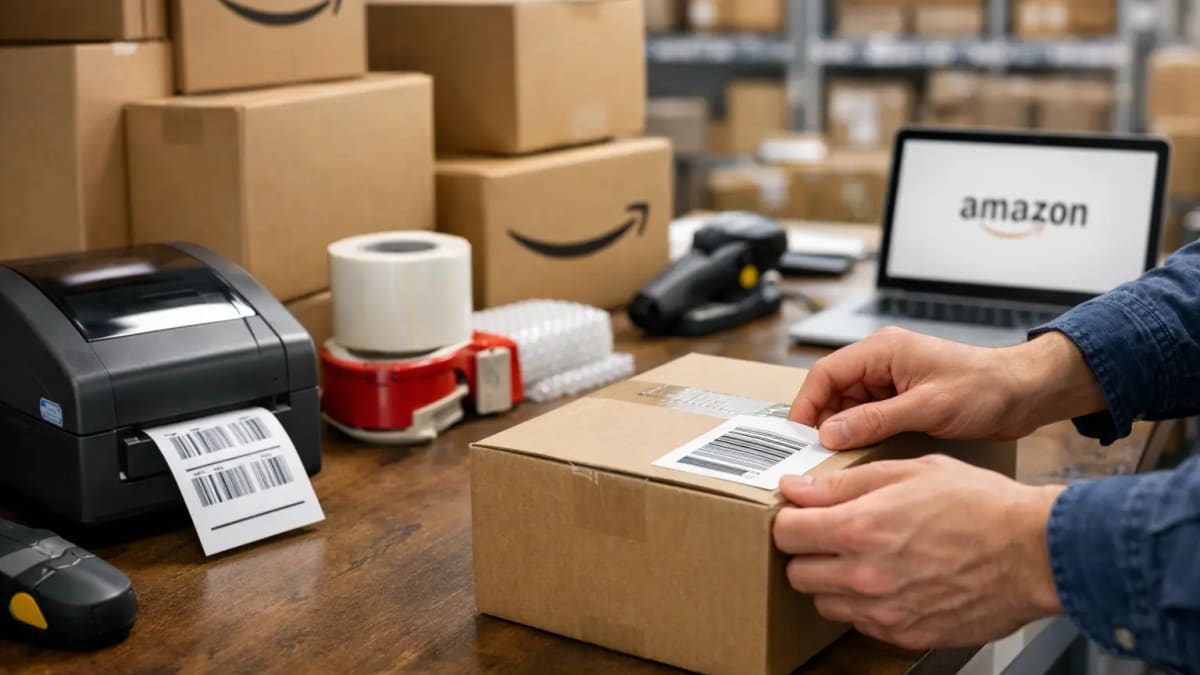
A shipment can be fully sourced, packed and ready to move, then get held up by something as small as a missing barcode. That is why demand for a reliable FNSKU labelling service UK sellers can depend on keeps growing. For Amazon brands, the label is not a minor admin task. It is what connects each unit to the right listing, the right seller account and the right inbound workflow.
When that process slips, the cost is rarely limited to relabelling fees. It can mean delayed check-in, stranded stock, compliance issues and unnecessary pressure on your operations team. If you are scaling across Amazon while also managing Shopify, TikTok Shop or wholesale orders, labelling accuracy quickly becomes an operational control point rather than a warehouse extra.
What an FNSKU labelling service UK operation should actually do
At a basic level, FNSKU labelling means applying the correct Amazon barcode to each sellable unit before it reaches the fulfilment centre. In practice, the job is more exact than that. The label has to match the product, sit in the correct position, remain scannable and, where required, cover any conflicting manufacturer barcode.
A capable FNSKU labelling service UK provider should not treat this as a one-step task. It sits inside a broader prep workflow that includes goods-in checks, SKU verification, condition assessment and shipment staging. If those controls are missing, the label may be correct in isolation but still attached to the wrong item, damaged packaging or a unit that does not meet Amazon prep requirements.
This is where process discipline matters. Barcode validation, batch control and SOP-led handling reduce the kind of errors that create downstream problems. For a growing seller, that means fewer surprises once inventory is already on the move.
Why FNSKU accuracy matters more as volume grows
At low volume, sellers often handle prep on a table in the office or at home and catch issues manually. That can work for a while. The pressure starts when inbound shipments become frequent, SKU counts rise and the same business is also managing direct-to-consumer fulfilment, customer service and stock purchasing.
At that point, small labelling errors stop being isolated mistakes. They become repeat operational drag. A wrong barcode can trigger receiving delays. A poorly placed label can fail to scan. Mixed cartons can complicate reconciliation. If you are launching new lines, creating bundles or sending replenishment into multiple Amazon fulfilment centres, the margin for error shrinks quickly.
The right setup is not just about getting labels printed. It is about building a controlled prep environment that keeps inventory moving without creating hidden exceptions for your team to fix later.
What to look for in an FNSKU labelling service UK provider
The strongest providers focus on compliance and flow, not just output volume. That means they should be able to receive stock, verify units against your instructions, apply labels consistently and prepare cartons for onward forwarding without introducing delay.
Speed matters, but only when it sits alongside accuracy. A fast warehouse with weak controls can create more cost than it removes. On the other hand, a methodical operation with no urgency can hold back replenishment and affect stock availability. The balance you want is same-day or rapid processing supported by barcode-led validation and clear intake procedures.
It also helps if the provider understands Amazon prep as part of a wider e-commerce operation. Many sellers do not run Amazon in isolation. They are splitting stock across FBA, FBM and other channels. A warehouse partner that can manage FNSKU labelling alongside storage, DTC dispatch, returns and shipment forwarding gives you more flexibility as demand changes.
Systems and visibility are not optional
A spreadsheet and a roll of labels might manage ten cartons. They do not scale cleanly when stock is arriving from multiple suppliers, products are selling across several channels and your team needs current inventory visibility.
A well-run prep and fulfilment operation should give you real-time status, clear booking procedures and structured exception handling. If there is a discrepancy in quantities, damaged stock or unclear prep instructions, you need that flagged early. Sellers lose time when issues are discovered only after Amazon rejects a shipment or receiving stalls.
Operational visibility also matters commercially. Better stock accuracy supports better purchasing decisions, more reliable replenishment planning and less dead time spent chasing what happened to a delivery.
Common FNSKU labelling mistakes that cost sellers money
Most costly prep errors are not dramatic. They are repetitive and preventable. Labels printed at the wrong scale, barcodes applied over curved packaging, units sent with exposed manufacturer codes, or bundles labelled inconsistently can all create friction at check-in.
Another common issue is treating every product the same. Some lines need poly bagging, suffocation warnings, expiry date handling or carton-specific prep before they are Amazon-ready. Labelling is only one part of compliance. If a provider only handles the sticker application but not the surrounding prep standards, the seller still carries the risk.
There is also a timing issue. Leaving labelling until the last minute can compress the entire inbound timeline. If your replenishment model depends on tight stock turns, any rework or hold-up can push listings closer to low-stock status. For fast-moving products, that can hit ranking and sales momentum.
In-house labelling vs outsourced prep
Some businesses should keep FNSKU labelling in-house. If your SKU range is narrow, order volume is stable and you already have trained warehouse staff with proper controls, internal prep can be cost-effective. You retain direct oversight and can make quick changes when Amazon updates requirements.
But that model becomes harder to justify when labour is inconsistent, storage is limited or the same team is juggling wholesale receipts, marketplace orders and returns. In those cases, outsourced prep often improves throughput because the workflow is already built around receiving, verification, labelling and dispatch.
The trade-off is control versus efficiency. Bringing in a specialist partner means trusting another operation with a critical compliance step. That only works if their processes are tighter than what you can maintain internally. For many scaling sellers, that is the real decision point.
How a structured prep workflow keeps Amazon shipments moving
The most effective FNSKU operations are built around repeatable stages. Stock is booked in, counted, checked against instructions and separated by SKU before labels are applied. Units are then validated, packed to shipment requirements and staged for forwarding. That structure reduces ad hoc handling and lowers the chance of mixed inventory or missed prep steps.
For sellers, the value is not only fewer errors. It is predictability. You know how long intake should take, how exceptions are handled and when goods are likely to be ready for Amazon delivery. That makes replenishment planning easier, especially during peak periods or product launches.
This is where a specialist 3PL can add more value than a basic prep house. If the same operation can receive containers or supplier deliveries, apply FNSKU labels, complete additional Amazon prep, hold reserve stock and support FBM or direct-to-consumer dispatch, your inventory works harder without needing multiple handoffs. That kind of setup suits brands that want smart fulfilment rather than one isolated service.
When a UK-based service makes the most sense
For UK sellers, using a local provider usually improves speed, communication and inbound control. Domestic receiving is simpler to coordinate, and issue resolution is generally faster when your prep partner understands the local carrier network, Amazon routing expectations and the operational pace of UK e-commerce.
A UK-based service is especially useful if your suppliers are shipping into the country from different origins and you need stock consolidated, checked and forwarded cleanly. It can also support businesses managing both Amazon and non-Amazon orders from one inventory position. Instead of building separate workflows, you create a more centralised operation with better oversight.
For brands at that stage, a provider such as PickPackPro fits best when the requirement goes beyond labels alone. The benefit comes from combining FNSKU compliance with storage, dispatch accuracy, returns handling and scalable warehouse support.
Amazon growth rarely stalls because a seller lacks ambition. It stalls when operations become too manual to support the next level. FNSKU labelling looks simple from the outside, but in practice it sits at the point where compliance, stock accuracy and speed all meet. Get that process right, and the rest of your inbound flow gets easier to control.

Comments
Share your thoughts. No account needed — once posted, comments cannot be edited.
Loading comments…