
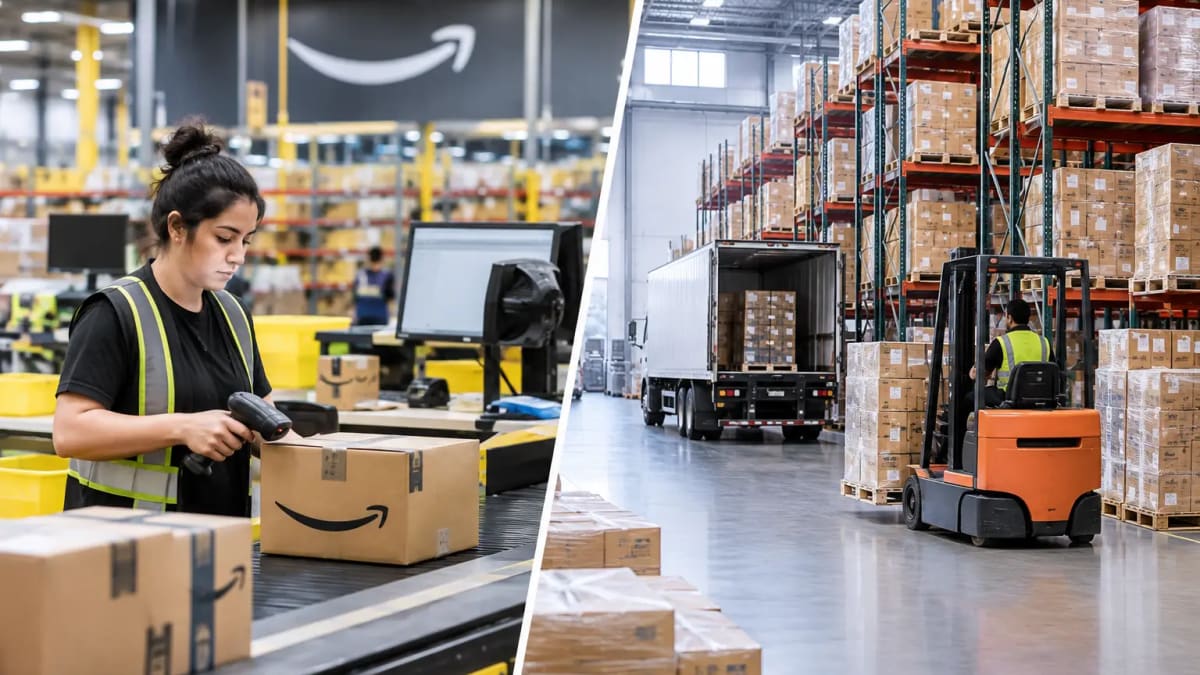
A shipment that misses an Amazon delivery window, arrives with incorrect FNSKU labels or fails carton requirements can create costs far beyond a delayed launch. For growing sellers, the amazon prep vs own warehouse decision is not simply about where stock sits. It determines how reliably inventory reaches Amazon fulfilment centres, how much management time the operation absorbs and how easily the business can respond to demand.
Both models can work well. The right choice depends on your product range, order volume, cash position, in-house operational capability and plans for multi-channel growth. The strongest decision is usually the one that protects accuracy and compliance without creating fixed costs ahead of revenue.
What Amazon prep and an own warehouse actually mean
Amazon prep is the use of a specialist third-party provider to receive stock, inspect it, prepare it to Amazon’s requirements and forward it to the assigned fulfilment centres. Services commonly include FNSKU labelling, poly bagging, bundling, expiry-date checks, carton labelling, pallet preparation and shipment booking. A capable provider can also hold inventory and dispatch direct-to-consumer orders for Shopify, TikTok Shop and Amazon FBM.
An own warehouse means your business leases or owns space and employs a team to carry out these processes internally. You control the layout, systems, staff rotas, stock movements and quality checks. For some established brands, this control is commercially valuable. It also makes the business responsible for every operational detail, from goods-in discrepancies to courier collections and health and safety procedures.
The distinction matters because Amazon FBA prep is a specialised workflow, not basic storage. Each unit and carton must meet changing marketplace requirements. A warehouse that is suitable for holding stock is not automatically set up to process Amazon inventory accurately at speed.
Amazon prep vs own warehouse: the real cost comparison
The headline cost of outsourced prep is easy to see: a per-unit, per-carton or per-service charge, plus storage and transport where applicable. An own warehouse can appear cheaper because the cost of each label or poly bag is low once space and staff are in place. That comparison is incomplete.
A self-operated facility carries fixed overheads whether volume is high or low. Rent, business rates, utilities, warehouse management software, racking, insurance, equipment, staff wages, holiday cover, training and management time all need to be funded. You must also pay for capacity before you need it if you expect to grow.
Outsourced Amazon prep converts much of that overhead into a variable operational cost. You pay for the work performed and the storage used. This is particularly useful for private-label launches, wholesale sellers with uneven inbound deliveries and brands with seasonal peaks. A business can process a larger shipment during Q4 without taking on a larger lease or recruiting temporary warehouse labour.
That does not mean outsourcing is always the lowest-cost route. High-volume sellers with stable, predictable product flows may reach a point where their own facility delivers a lower unit cost. The calculation should include the full cost of management and error correction, not only rent and hourly pay. A small saving per unit can disappear quickly if incorrect labelling causes rejected deliveries, stranded inventory or a rushed rework job.
Control is valuable only when it is operationally useful
An own warehouse gives direct physical control. You can prioritise a particular SKU, inspect every delivery personally, change a packing method immediately and decide how much buffer stock to hold. This suits brands with unusual handling needs, complex kitting or highly sensitive products that require close internal oversight.
However, control can become a bottleneck when the founder remains responsible for daily warehouse decisions. If every exception, replenishment plan or staff query lands with the business owner, the operation may be controlled but not scalable. Time spent printing labels and resolving courier issues is time removed from sourcing, advertising, product development and cash-flow management.
A specialist prep partner provides process control rather than physical ownership. Clear standard operating procedures, barcode validation, photographed exceptions and agreed service levels allow you to monitor work without managing each task. The key is choosing a provider that gives visibility of stock, communicates discrepancies quickly and follows documented instructions consistently.
Compliance is where the decision often becomes clear
Amazon requirements are detailed and can change. A seller must manage product labelling, packaging rules, suffocation warnings, carton content information, box weight limits, inbound shipment plans and delivery appointment requirements. Particular categories may also need batch tracking, expiry-date management or additional product documentation.
An internal warehouse can achieve excellent compliance, but only with trained people, reliable processes and regular quality checks. One knowledgeable team member is not a system. If that person is absent during a major inbound delivery, the risk increases.
A dedicated Amazon prep operation handles these workflows repeatedly. Its team understands the consequences of a missing label, an unreadable barcode or mixed inventory in the wrong carton. This repetition supports consistent execution, especially when a seller has multiple suppliers delivering stock from the UK, Europe or overseas.
For international sellers holding stock in the UK, a prep centre can also reduce operational friction. Inventory can be received locally, checked against expected quantities and routed to UK Amazon fulfilment centres without the brand needing to establish its own warehouse infrastructure. A Milton Keynes location can be particularly practical for national carrier access and inbound routing, but process quality matters more than postcode.
Capacity should follow demand, not guesswork
A warehouse lease is a long-term capacity decision. If your sales double, can the building, racking and team accommodate the increase? If sales soften, can the business comfortably carry the cost? These questions matter most for businesses with seasonal trading patterns or fast-changing product lines.
Third-party prep offers flexible capacity. A provider with trained warehouse staff, defined goods-in procedures and established carrier collections can absorb more units without requiring the seller to redesign an operation. This lets brands test new marketplaces, increase replenishment frequency or prepare for peak periods with less fixed commitment.
There are limits. A prep provider needs accurate forecasts, clear booking information and realistic turnaround expectations. Sending a large shipment without notice and expecting immediate processing is not a scalable plan. The best outsourced relationship works as an extension of your operations team: you share launch dates, inbound schedules, product changes and sales forecasts early enough to plan labour and space.
Your sales channels change the answer
If your business only sends a small number of predictable FBA shipments each month, either option may be viable. The decision becomes more complex when you sell across several channels. Amazon FBA replenishment, Seller Fulfilled Prime, Amazon FBM, Shopify orders and TikTok Shop orders each have different dispatch expectations.
Running these channels from an own warehouse requires multiple inventory rules, courier services, packaging standards and cut-off times. It is achievable, but the operation needs a warehouse management system that prevents overselling and directs the correct stock to the correct order.
A multi-channel fulfilment partner can centralise these workflows. Stock is received once, allocated accurately and dispatched through the appropriate channel. For example, the same product range may need FBA prep for a replenishment shipment while direct customer orders require same-day pick and pack. This model reduces duplicate handling and supports smarter use of inventory.
PickPackPro is structured for this type of blended operation, combining Amazon-focused prep with barcode-validated e-commerce fulfilment. The commercial benefit is not simply outsourcing tasks. It is having one operational process that can support changing channel demand.
When an own warehouse is the stronger choice
Operating your own warehouse may be right when you have sustained volume, a stable product catalogue and enough margin to support a professional warehouse team. It is also worth considering where products need specialist equipment, highly customised assembly or controlled handling that a general fulfilment provider cannot provide.
Before committing, build a realistic operating model. Include peak staffing, sickness cover, equipment replacement, supervisory time, stocktake resource and the cost of space required for growth. Test whether the model still works if sales are 30 per cent lower than forecast for six months. A warehouse should give the business resilience, not lock it into pressure.
When Amazon prep is the better route
Outsourced prep is often the more practical route for sellers who are growing, launching new products or managing variable inbound volumes. It is especially effective when Amazon compliance is consuming too much internal time, when storage at home or in a small unit is no longer viable, or when the brand wants to add direct-to-consumer fulfilment without creating a separate warehouse operation.
The provider should be assessed on more than price. Ask how goods are checked on arrival, how discrepancies are recorded, whether every unit is barcode validated, how quickly orders are processed and what happens when Amazon instructions change. Confirm their approach to storage, stock reporting, insurance, carrier handover and peak-period capacity. Precise answers indicate a process-led operation.
The best model is the one that lets your business fulfil with precision while keeping management attention on growth. Start with the operational pressure you need to remove, model the true cost of doing it yourself and choose capacity that allows you to scale with confidence rather than simply cope with the next shipment.

Comments
Share your thoughts. No account needed — once posted, comments cannot be edited.
Loading comments…