
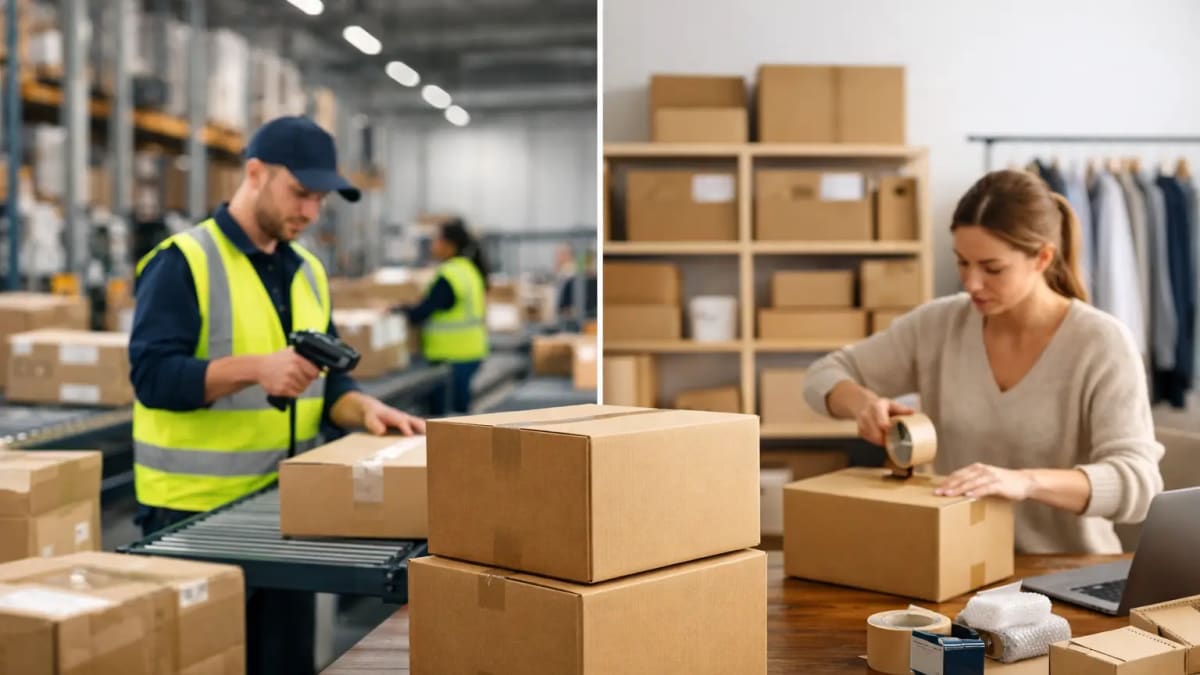
A missed dispatch cut-off can turn a strong sales day into late-delivery enquiries, poor marketplace metrics and a warehouse team working into the evening. The 3PL versus self fulfilment decision is not simply about who packs the parcels. It determines how reliably your business can meet customer expectations, stay marketplace-compliant and absorb growth when order volume changes quickly.
For a new seller dispatching a manageable number of orders from a spare room, self fulfilment can make commercial sense. For a brand processing orders across Amazon, Shopify, TikTok Shop and wholesale channels, the operational picture is different. The right model depends on order profile, margin, product requirements, growth plans and how much management time your team can realistically commit to the warehouse.
3PL versus self fulfilment: the operating difference
Self fulfilment means your business controls stock storage, picking, packing, courier bookings, customer returns and the people required to complete those tasks. You may work from a home office, a small unit or a dedicated warehouse. Every process sits within your team, from printing the order label to investigating a stock discrepancy.
A third-party logistics provider, or 3PL, performs those warehouse functions on your behalf. Stock is received into its facility, recorded in a warehouse management system and dispatched against orders received through connected sales channels. A capable provider can also manage Amazon FBA preparation, Seller Fulfilled Prime workflows, returns, pallet preparation and multi-channel stock allocation.
Neither route is automatically better. Self fulfilment favours direct oversight and can be cost-effective at low, consistent volume. A 3PL is designed to provide operational capacity, structured processes and technology without requiring you to build those capabilities internally.
When self fulfilment gives you an advantage
Control is the principal benefit of fulfilling orders in-house. Your team can inspect every product, introduce a handwritten insert, change packaging quickly and respond to unusual customer requests without briefing an external partner. This can be valuable for early-stage brands with highly customised products, fragile items or a premium unboxing experience that changes frequently.
It also gives founders immediate visibility. You can see stock on the shelf, identify a slow-moving line and spot a packing issue as it happens. Where daily order volume is modest and stock is simple, this direct involvement can be useful rather than distracting.
The cost profile can look attractive at first because much of the labour is supplied by the founder or existing team. That calculation becomes less clear as volume rises. The real cost of self fulfilment includes rent, racking, packing benches, packaging, insurance, warehouse staff, holiday cover, training, courier collections, software and the time spent resolving exceptions. It also includes the opportunity cost of senior people packing parcels instead of improving products, acquiring customers or managing suppliers.
Where a 3PL creates commercial leverage
A 3PL replaces fixed warehouse overhead with a service model that can move more closely with order activity. Rather than committing to a larger unit, recruiting seasonal staff and purchasing more equipment before peak, you access an established warehouse operation built for receiving, storage, pick and pack and dispatch.
For multi-channel sellers, the operational benefit is often greater than the headline saving. Connected systems can route orders from different storefronts into one fulfilment workflow, while barcode validation supports picking accuracy and real-time inventory data gives your team a clearer view of stock. This reduces the risk of overselling the same units across several channels.
Marketplace compliance is another decisive factor. Amazon sellers must manage requirements around FNSKU labels, poly bagging, carton labelling, bundle preparation, shipment plans and delivery appointments. These tasks are repeatable but unforgiving. An experienced 3PL uses documented SOPs and trained warehouse teams to complete them consistently, protecting stock from avoidable rejections, delays and rework.
Speed also matters. Same-day dispatch is difficult to maintain when your own operation is dealing with supplier deliveries, staff absence or a sudden sales spike. A properly resourced fulfilment partner can work to agreed cut-offs and service levels, allowing the dispatch operation to continue without being dependent on one person knowing where everything is stored.
Compare the full cost, not just the pick fee
The most common error in this decision is comparing a 3PL pick-and-pack charge against the cost of a postage label. Postage exists in both models. The more useful comparison is between the total landed cost of each operating model.
For self fulfilment, calculate premises, utilities, labour, employer costs, management time, packaging, storage equipment, software subscriptions, error-related refunds, insurance and the cost of unused warehouse capacity. Then include the investment required for the next stage of growth, not only your current volume.
For a 3PL, model receiving fees, storage, pick and pack, packaging, returns handling, special project work and courier charges. Ask how pricing changes with order complexity. A one-item order, a three-item bundle, an FBA carton and a return inspection require different amounts of work.
The lowest unit price is not always the strongest commercial outcome. A cheaper process that creates dispatch errors, stock inaccuracies or poor customer feedback can cost far more than it saves. The target is predictable fulfilment cost alongside reliable execution.
Control does not disappear when you outsource
Some brands assume outsourcing means losing visibility over their stock. That can happen with an unsuitable provider, but it should not be the standard. The right 3PL gives your team visibility through reporting, stock records, order statuses and agreed escalation routes while taking daily warehouse execution off your desk.
The distinction is between controlling every task and controlling the outcome. You still set packaging standards, product handling rules, service requirements and replenishment priorities. Your 3PL should convert those requirements into clear operational instructions, then report performance against them.
This is particularly important for brands that sell through Amazon and direct-to-consumer channels simultaneously. Stock allocation rules need to be deliberate. If Amazon demand accelerates, you need to know whether sufficient units remain available for Shopify, TikTok Shop or wholesale orders. Structured inventory controls make that decision manageable.
Speed, accuracy and compliance under pressure
Peak trading periods expose the weak points in self fulfilment. A promotion, influencer mention or Prime event can create a volume increase that is welcome commercially but difficult operationally. Temporary labour needs training. Packing stations become congested. Courier collections may be missed. Returns build up while the team focuses on new orders.
A 3PL should be built to manage these pressures through defined receiving schedules, barcode-led picking, quality checks, dispatch cut-offs and capacity planning. This does not mean every external warehouse will perform at the same level. Service quality depends on systems, staffing, process discipline and communication.
Before outsourcing, ask how the provider handles order exceptions, damaged stock, inventory discrepancies, urgent requests and peak-volume forecasts. Ask how it validates picks and whether it can support your marketplace-specific requirements. A provider that gives vague answers on these points may create friction rather than remove it.
The signs you have outgrown self fulfilment
There is no universal order-volume threshold. A seller shipping 30 complex, personalised orders a day may need specialist support sooner than a seller dispatching 200 identical items. The decision usually becomes urgent when warehouse work is limiting commercial progress or delivery performance.
Warning signs include regularly missing dispatch cut-offs, running out of storage space, relying on founders for daily packing, struggling to recruit and train warehouse staff, holding inaccurate stock figures or delaying expansion to another sales channel because operations cannot support it. Rising returns and marketplace account-health issues are also operational signals, not merely customer-service problems.
For many growing brands, a hybrid period is sensible. Keep highly customised or low-volume lines in-house while placing standard products, Amazon prep or high-volume direct-to-consumer orders with a 3PL. This approach lets you test provider performance without moving every SKU at once.
How to make the transition work
Outsourcing succeeds when it is treated as an operational project, not a hurried stock transfer. Start with accurate product data: dimensions, weights, barcodes, storage requirements, bundle rules and packaging instructions. Poor master data creates receiving delays and avoidable fulfilment exceptions.
Next, map the customer journey from order placement to return. Define cut-off times, delivery services, branded packaging requirements, replacement-order rules and the actions required when stock is damaged or missing. These instructions should be clear enough for a warehouse team to follow without interpretation.
Run a controlled onboarding period with a limited product range or channel where possible. Check inventory reconciliation, order transmission, tracking updates, dispatch performance and returns workflows before increasing volume. PickPackPro supports this kind of structured transition with multi-channel integrations, barcode-validated processes and Amazon-focused preparation capability designed for growing UK sellers.
Choose the model that protects growth
Self fulfilment is often the right training ground for an e-commerce business. It teaches you how customers order, where products are vulnerable and which delivery promises matter most. But it should not become a permanent constraint simply because it worked at the beginning.
Choose a 3PL when structured warehouse execution will free your team to grow revenue while improving speed, accuracy and compliance. Choose self fulfilment when your order profile genuinely benefits from close, hands-on control and you have the capacity to maintain service standards. The best decision is the one that lets your customers receive every order with the consistency your brand has promised.

Comments
Share your thoughts. No account needed — once posted, comments cannot be edited.
Loading comments…