
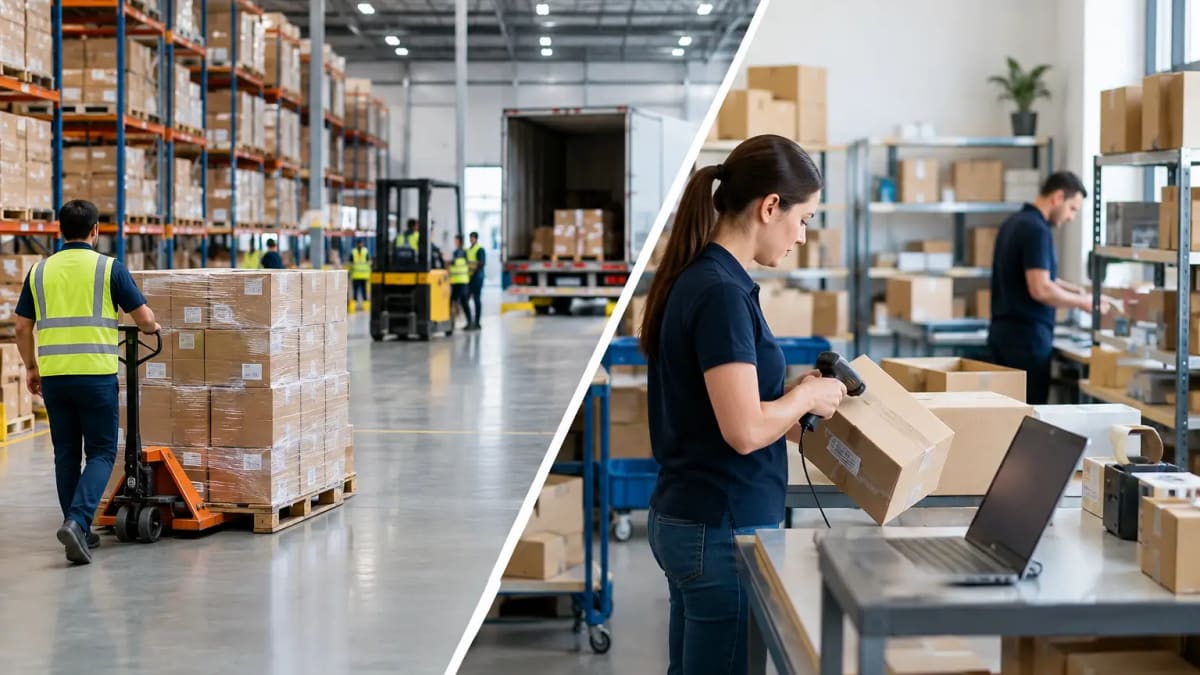
A sudden rise in orders should be a commercial win, not the point at which dispatch errors, late carrier collections and stock discrepancies start to affect your customer experience. The choice between 3PL versus in-house fulfilment determines how much capacity your business can create before operational work begins to limit sales.
For Amazon sellers, Shopify brands and TikTok Shop merchants, the right answer is rarely based on order volume alone. It depends on the complexity of your stock, the promises you make to customers, the time your team spends in the warehouse and the cost of getting fulfilment wrong.
What In-House Fulfilment Gives You
In-house fulfilment means your business receives stock, stores it, picks orders, packs parcels, manages carrier collections and handles returns using your own premises and team. It can be run from a home, a small unit or a dedicated warehouse.
Its main advantage is direct control. You can inspect every product, change packaging immediately and make a last-minute decision without needing to communicate it to a partner. For a small catalogue, predictable order levels and products that need specialist knowledge or delicate handling, this can be valuable.
It also gives founders a close view of customer behaviour. You see which items sell together, which products regularly arrive damaged and where packaging creates unnecessary cost. Early in a brand's life, that operational insight can be useful.
However, direct control is not the same as operational resilience. In-house fulfilment makes the business responsible for every process and every point of failure. A staff absence, a delayed delivery, a missed courier cut-off or an inaccurate stock count sits with your team. As sales grow, founders often find that their most profitable hours are being consumed by picking, printing labels and resolving warehouse exceptions.
The true cost is more than rent and postage
The visible costs of in-house operations are straightforward: premises, shelving, packing materials, wages, insurance, software and courier charges. The less visible costs are usually more significant.
Consider the labour required to receive and check inbound stock, create product records, apply FNSKU labels, prepare Amazon shipments, replenish pick locations, complete cycle counts, answer delivery queries and process returns. Add training, holiday cover and the cost of unused space during quieter months. These costs do not disappear because they are handled by the owner or an existing employee.
Accuracy also has a commercial value. One incorrectly dispatched order can mean replacement stock, additional carriage, customer service time and a poor review. For marketplace sellers, repeated performance issues can threaten account health, Buy Box eligibility or the ability to meet premium delivery commitments.
Where a 3PL Changes the Equation
A third-party logistics provider operates the warehouse infrastructure, fulfilment team, systems and carrier network on your behalf. Your stock is stored at the provider's facility, while orders flow from your connected sales channels into a managed pick, pack and dispatch operation.
The benefit is not simply that someone else packs parcels. A capable 3PL turns a fixed operational burden into a service that can expand with demand. You pay for the storage, handling and value-added work your business needs, rather than carrying the full cost of warehouse capacity all year.
For multi-channel sellers, this can be particularly effective. Inventory can be allocated to direct-to-consumer orders, Amazon FBM orders, Seller Fulfilled Prime workflows and FBA replenishment without maintaining separate teams or storage locations for each route to market.
A specialist provider should also bring established warehouse disciplines: barcode validation, documented standard operating procedures, stock control routines, dispatch cut-off management and clear exception handling. These processes reduce reliance on individual knowledge and make performance more repeatable as volumes increase.
3PL versus in-house: control is not lost, it changes
Many founders worry that outsourcing means giving up control. In reality, the question is whether control lives in your hands-on warehouse activity or in the standards you set and measure.
With an in-house operation, you can walk to the packing bench and change a process instantly. With a 3PL, you should define requirements through agreed SOPs, packaging specifications, service levels, reporting and escalation routes. You trade immediate physical access for structured operational management.
That trade-off works well when the provider understands your channels and communicates clearly. It works poorly when onboarding is rushed, product data is incomplete or the provider cannot support the specific requirements of your business. Amazon FBA prep, for example, needs reliable FNSKU labelling, poly bagging, bundling, carton compliance and shipment forwarding. These are not optional details that can be resolved after stock has arrived.
When In-House Fulfilment Still Makes Sense
Outsourcing is not automatically the best decision. In-house fulfilment can remain practical when order volumes are low and stable, your product range is simple, and you have suitable space and trained staff already in place.
It may also be the better route where products need bespoke assembly, highly sensitive quality checks or specialist product knowledge that is difficult to document. A luxury item with personal finishing requirements is different from a standard catalogue product picked against a barcode.
The key is to assess whether the operation remains efficient as demand rises. If your team can dispatch accurately before carrier cut-off, maintain stock records and continue working on revenue-generating tasks, there may be no urgent reason to change. The aim is not to outsource for its own sake. It is to avoid building an operation that slows the company it is meant to support.
Signals That It Is Time to Consider a 3PL
A move to outsourced fulfilment is usually prompted by operational friction rather than one magic order threshold. Watch for recurring signs: dispatch is taking over evenings and weekends; a sales promotion creates backlogs; stock is spread across unsuitable spaces; errors increase during busy periods; or you are delaying new marketplace launches because the warehouse cannot cope.
Amazon sellers should pay close attention to compliance workload. Preparing inventory for fulfilment centres, maintaining labelling standards and routing stock correctly can absorb substantial time. Brands supporting Seller Fulfilled Prime or fast marketplace delivery also need dependable cut-off performance, stock accuracy and carrier management every working day.
International brands entering the UK face a similar challenge. A UK fulfilment partner can hold stock locally, dispatch domestic orders faster and route inventory to UK Amazon fulfilment centres without requiring the brand to establish its own warehouse operation. A centrally located facility, such as one in Milton Keynes, can be useful for national carrier access and inbound stock routing.
Compare the Numbers Before You Decide
Do not compare your current warehouse rent only with a 3PL storage rate. Build a like-for-like operating model over at least six to twelve months, including peak trading periods.
Start with all internal labour, including founder time. Add premises costs, utilities, warehouse equipment, software, packaging, insurance, recruitment, training, carrier surcharges, damaged stock and the cost of errors. Then account for the capacity you need for peak volume, not just average weekly orders.
Against this, model the 3PL's receiving fees, storage, pick and pack charges, packaging, returns processing, value-added services and any minimum charges. Ask how pricing changes by order profile. A single-item order, a five-line basket, a pallet inbound and an Amazon prep project should not be treated as identical work.
Cost matters, but service fit matters just as much. A low unit rate has little value if it cannot support same-day dispatch, accurate integrations or the specific presentation your brand requires. Ask for clarity on stock ownership, inventory reporting, claims procedures, onboarding timescales, cut-off times and peak capacity.
Build a Transition Plan, Not a Stock Move
Moving fulfilment is an operational project. The strongest transitions begin with accurate product data, barcodes, dimensions, weights, packaging instructions and clear rules for exceptions. Every SKU should have an agreed handling method before it reaches the warehouse.
Connect sales channels and test order flows before live stock is fully transferred. Confirm how cancellations, address changes, partial shipments, out-of-stock items and returns will be handled. If you sell through Amazon, Shopify and TikTok Shop, establish which system is the source of truth for inventory and how overselling will be prevented.
Begin with a controlled stock transfer where possible, then monitor receiving accuracy, order turnaround, tracking updates and customer feedback closely. Good onboarding is not an administrative detail. It is the foundation for fulfilment that remains accurate when your volumes increase.
The best decision is the one that gives your brand enough operational discipline for today and enough capacity for the next growth phase. If warehouse work is preventing your team from improving products, acquiring customers and expanding channels, it is time to assess whether smart fulfilment support will let you scale with confidence.

Comments
Share your thoughts. No account needed — once posted, comments cannot be edited.
Loading comments…