
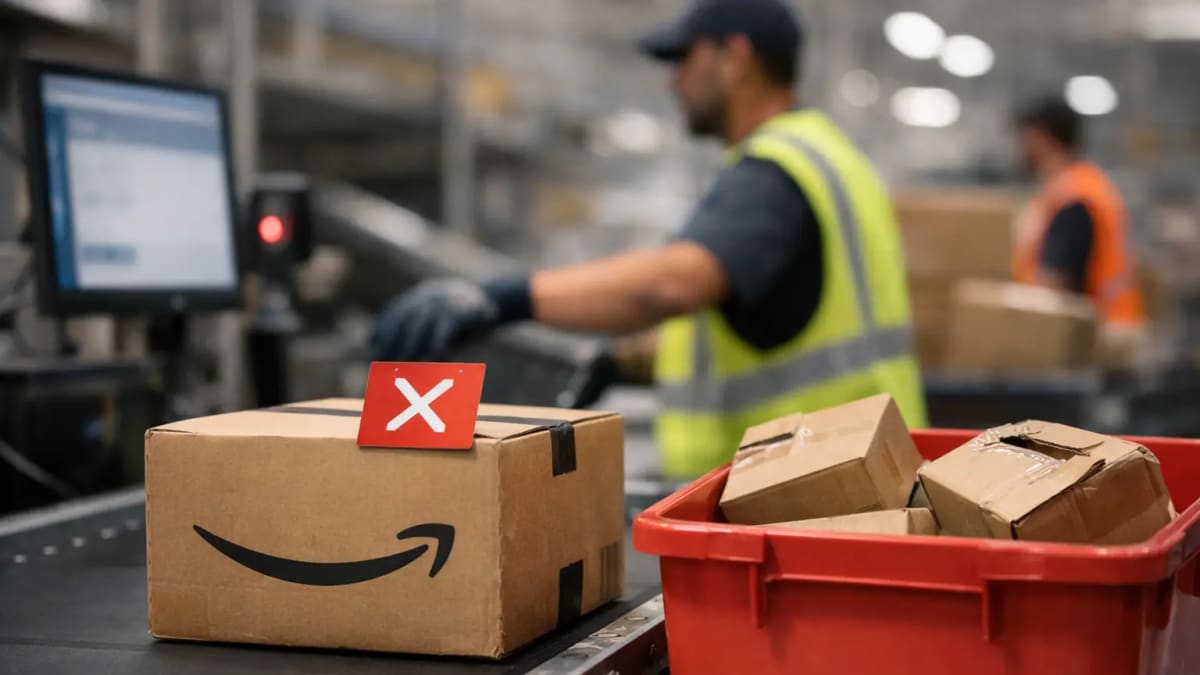
A carton can be packed neatly, booked onto the correct shipment and still be stopped at an Amazon fulfilment centre. So, why are Amazon cartons rejected? Usually, the issue is not the product itself. It is a mismatch between the carton received and the shipment plan, labelling, packing or routing information Amazon expects to see at intake.
For a growing seller, a rejected carton is more than an inconvenience. It can delay stock becoming available, create additional handling charges, lead to inventory being returned, and put pressure on launch dates or replenishment plans. The most reliable way to avoid it is to treat FBA prep as a controlled compliance process, not a final packing task.
Why are Amazon cartons rejected at FBA intake?
Amazon receiving teams and automated systems need to identify each carton quickly, associate it with a live inbound shipment and process its contents safely. When a carton cannot be scanned, does not match the plan, is unsuitable for handling, or has been sent to the wrong location, it may be rejected, delayed or flagged for investigation.
The precise outcome depends on the fault, the fulfilment centre and the shipment settings in force at the time. A minor label issue may mean a delay and manual correction. A serious safety, routing or packaging issue can result in refused delivery, returned stock or non-compliance fees.
The recurring causes tend to fall into four operational areas: shipment-plan accuracy, carton and product labelling, physical packaging, and carrier handover. Each needs a clear check before goods leave the warehouse.
Shipment plan errors that stop cartons moving
An FBA shipment is not simply a delivery booking. It is a specific instruction set: which SKUs are being sent, in what quantities, in how many cartons, to which receiving destination, and with which carton identifiers. If the physical shipment differs from those instructions, Amazon has a reason to query it.
Carton contents do not match the shipment
This is one of the most common causes of receiving problems. A seller may create a plan for 24 units of one SKU, then pack 20, 25 or a mixture of products into the carton without updating the shipment. The carton label may scan, but the expected inventory and actual inventory do not align.
Mixed-SKU cartons require particular discipline. Every product must be correctly prepped and individually identifiable, while the carton contents submitted in Seller Central must reflect what is physically packed. Do not rely on a packing team’s memory or a handwritten carton note. Use a barcode-led count and a final carton reconciliation.
Wrong carton quantity or duplicate box labels
A shipment created for ten cartons cannot safely become nine or eleven cartons at dispatch unless the plan is amended first. Equally, printing a box label twice and applying the same label to two different cartons creates a traceability failure. Amazon may see two cartons claiming the same identity.
Box labels should be printed from the final shipment plan, applied once only, and checked against the carton number before palletisation. If a carton is repacked after labels are applied, the label and its contents must be revalidated.
Incorrect destination or split-shipment handling
Amazon may split an inbound shipment across several fulfilment centres. Sending all cartons to one site because it is more convenient for the carrier can result in rejection or redirection. The same risk applies when cartons for separate shipments are mixed onto a pallet without clear segregation.
Follow the routing shown on the confirmed shipment plan. Where multiple destinations are involved, separate the cartons physically, verify the labels by destination and ensure the carrier collection manifest reflects the final allocation.
Labelling failures: small errors with big consequences
Labels are the connection between stock, shipment data and physical handling. A label that is missing, obscured or unscannable turns a routine receipt into an exception.
FNSKU and product barcode issues
For products requiring Amazon barcode labelling, each sellable unit needs the correct FNSKU. It must cover any scannable manufacturer barcode that could cause the wrong identifier to be read, unless the product is approved for a different barcode arrangement.
Common faults include labels placed over curved surfaces, wrinkles across the barcode, poor thermal print quality, and an FNSKU applied to the outer pack but not each individual unit. A scan test before packing is faster and cheaper than discovering a problem after delivery.
Missing or unreadable carton labels
Each carton needs the correct Amazon shipment label, positioned on a flat, visible external surface. Labels should not sit over carton seams, corners, tape, straps or old labels. They should also be protected from moisture and abrasion during transport without covering the barcode with reflective or wrinkled material.
Remove or fully cover old carrier labels and previous FBA box labels. Multiple visible barcodes can cause a carton to be misrouted or create uncertainty at intake. A clean carton exterior makes automated receiving more reliable.
Labels applied to the wrong level of packaging
A product label, carton label and pallet label serve different purposes. Applying a carton label to a product unit, or assuming a pallet label replaces individual carton labels, breaks the receiving chain. Every level must carry the identification required for that level of handling.
This is particularly relevant for case-packed products. The outer case may be the sellable unit in one shipment, while in another it is simply a transit carton containing individual sellable units. The prep requirement depends on how the ASIN is configured and how the stock is being sent.
Physical carton and packaging problems
Amazon fulfilment centres receive high volumes of stock using conveyors, scanning equipment, pallet handling and manual processes. Cartons must survive that environment and comply with the relevant packaging rules.
The main physical reasons for rejection or delay include:
- damaged, wet, crushed or poorly sealed cartons;
- cartons that exceed the permitted size or weight for the shipment type;
- loose-fill packing that creates a safety or contamination concern;
- protruding staples, straps or sharp edges;
- cartons with insufficient internal protection, allowing products to move or break.
A strong outer carton alone is not enough. The product must be secure inside it, especially where cartons contain glass, liquids, fragile items or heavy units. Use suitable dunnage, keep weight distributed evenly and seal every opening properly. If a carton has been weakened in storage, replace it rather than reinforce it repeatedly with tape.
Weight limits deserve special attention. Heavy cartons may need team-lift markings or different handling arrangements, while oversized cartons can create restrictions depending on the inbound programme. Check the current shipment requirements before building the load. Amazon policies and operational rules can change, so a process based on last year’s limits is not a dependable control.
Pallet and delivery issues outside the carton itself
Sometimes the cartons are compliant, but the delivery presentation is not. Incorrect pallet dimensions, unstable stacking, overhang, inaccessible carton labels or unsuitable stretch wrapping can all slow acceptance at the delivery point.
For palletised FBA shipments, build square, stable pallets with cartons aligned to the edge rather than hanging over it. Keep shipment groups separate, place labels where they can be scanned without dismantling the pallet, and use wrapping that secures the load without hiding the required information. If the carrier books a vehicle or delivery type that does not match the fulfilment centre’s requirements, the whole consignment can be affected.
This is why handover matters. The warehouse, carrier and seller should work from the same confirmed shipment reference, destination and collection data. A final despatch check should confirm carton count, pallet count, labels, condition and paperwork before the lorry leaves.
A practical pre-despatch control process
The most effective prevention method is a short, repeatable SOP carried out after packing and before collection. It should combine system validation with physical inspection.
First, reconcile every SKU and unit quantity against the approved shipment plan. Next, scan the FNSKU or approved product barcode on a sample from each SKU and inspect the placement and print quality of labels. Then verify that every carton has one correct, readable shipment label and that the number of cartons matches the plan exactly.
After that, inspect carton condition, seals, weight, dimensions and internal security. Finally, check the routing, pallet configuration and carrier manifest against the shipment destination. Photographing completed pallets and retaining the carton count record can help resolve disputes if a problem arises after collection.
For higher volumes, barcode validation at pack bench level is more dependable than manual checking alone. It creates a traceable record that the right unit went into the right carton and makes exceptions visible before they become an inbound issue.
When the rejection happens despite good prep
Not every receiving exception means the seller packed incorrectly. Cartons can be damaged in transit, labels can be scuffed by handling, carrier routes can be disrupted, and receiving sites can experience operational backlogs. The key is to identify whether the issue occurred before collection, during transport or at fulfilment-centre intake.
Review the shipment status, carrier proof of delivery, carton records and any Amazon notification together. Avoid immediately resending stock without establishing the cause, as repeating the same configuration error can create another delay. A structured fulfilment partner can add value here by maintaining clear despatch records and controlled prep checks from inbound receipt through to shipment forwarding.
Amazon carton compliance is not about making boxes look tidy. It is about ensuring every carton tells the same accurate story as the shipment data behind it. Build that verification into the workflow, and FBA intake becomes far more predictable as your volume scales.

Comments
Share your thoughts. No account needed — once posted, comments cannot be edited.
Loading comments…